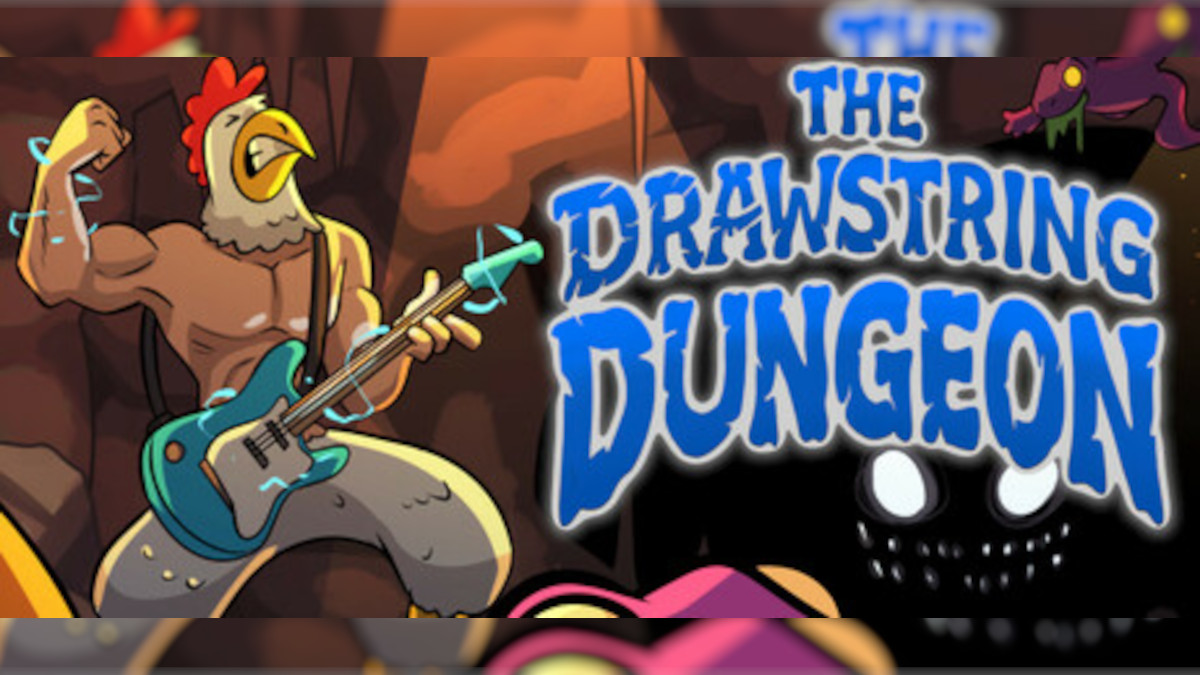
I’ve never been very good at deckbuilders. I always pick the wrong cards, forget what they’re all supposed to do, completely neglect to shield myself, and inevitably crumble up against even the weakest of enemies. However, every so often, a deckbuilder comes along that makes me forget my shortcomings. The Drawstring Dungeon is one such deckbuilder.
The Drawstring Dungeon is a deckbuilding roguelike in development by a small indie team, Sleeper Build Studio. They are a team of just three people set on making games that they want to see in the world, which is admirable, and that makes the game itself all the more impressive.
Cards and combos

We’ve already established that I’m terrible at understanding what individual cards do, but The Drawstring Dungeon takes things a step further and changes what cards do based on their combo level. Using a card first makes it weaker than if you use it second or third, depending on how much mana you have, so you need to really think about the order in which you use your cards.
You also need to pay attention to what the enemy is planning to do next so that you make the most of that combo mechanic. If they’re planning to attack, it’s a good idea to use your shield cards last so that the effect is increased, and so forth.
However, my usual play style of “all guns blazing” regularly makes me forget that fact, and I throw out all of my attack cards while forgetting that the shield cards exist, and by the time I do, I’ve run out of mana to use them.
Far from being a bad thing, it’s helped me improve my deckbuilding game. It’s made me really think, which I’m sure comes naturally to anyone who plays games of this genre more than I do, but for me, this learning curve is absolutely necessary. If you are a deckbuilder pro, though, you’ll have absolutely no issues balancing your
Enemies: Adorable and abominable

Every encounter with an enemy in The Drawstring Dungeon is different from the last, depending on the cards in your deck and the charms that you’ve placed on them. But all of the encounters have one thing in common: the enemies shine, although the reasons differ. For instance, you could face off against Sir Dunkin, who seems to be a paper bag with a basketball. He’s not too difficult to beat, and a lovely introduction to the mechanics if you happen to meet him.
If you’re unlucky, though, you could come up against some ZomBees. I hate ZomBees.
ZomBees don’t seem too challenging at first. They all have 15 health, and your attacks can get rid of a single ZomBee within a single turn. However, and this is where my negativity towards these buzzing undead insects begins, they spawn additional ZomBees if you fail to kill them. If you’re not quick or you’re dealt a bad hand, you can easily end up facing a full swarm.
Pick your boss

As with all deckbuilders, you’ll occasionally come across a boss that you need to fight, except in The Drawstring Dungeon, you have some control over what you end up fighting. Throughout a run, you’ll be able to select Mutations for the boss, changing it in one way or another.
If you’re more familiar with the genre, this ability to mould your enemy would be something that could be used to your advantage by choosing the mutations that can be combated with your cards. However, for this complete amateur, it has thus far been a case of choosing at random and hoping for the best.
It’s gone pretty horribly, truth be told.
But I am learning how to judge which mutation would be most beneficial. As with understanding the cards themselves, understanding the mutations and what they actually end up doing to the eventual boss has been a steep learning curve. More importantly, it’s been a fun learning curve, and that’s an achievement in and of itself.
All is not lost

One thing that I’ve always struggled with in deckbuilders, and roguelikes in general, is that feeling of having to start all over again if you mess up and end up dead. It gets tedious after a while, and I’ve never been a fan of repetition, but The Drawstring Dungeon has something that at least lessens the possibility of that happening: Extraction.
You have three chances to extract during each run, and doing so not only fully heals you but also offers a chance to change your major ability. Choosing to extract comes at a price, though, because you’ll be sent back to he last available checkpoint that you interacted with during that run. It’s always worth choosing routes that include tick marks, I’ve discovered.
If you want to dive into The Drawstring Dungeon, you don’t have long to wait. The full game is set to be released in July 2025. If you’re impatient, there’s a demo available to download and play right now, so you can get to grips with the various mechanics and meet some of the enemies.
The Drawstring Dungeon

Developer:
Sleeper Build Studio
Publisher:
Sleeper Build Studio
Release date:
July 1, 2025
Social links:


Platforms:
Leave a Reply